Tuesday, March 18, 2014

Our First Arabian Dust Storm

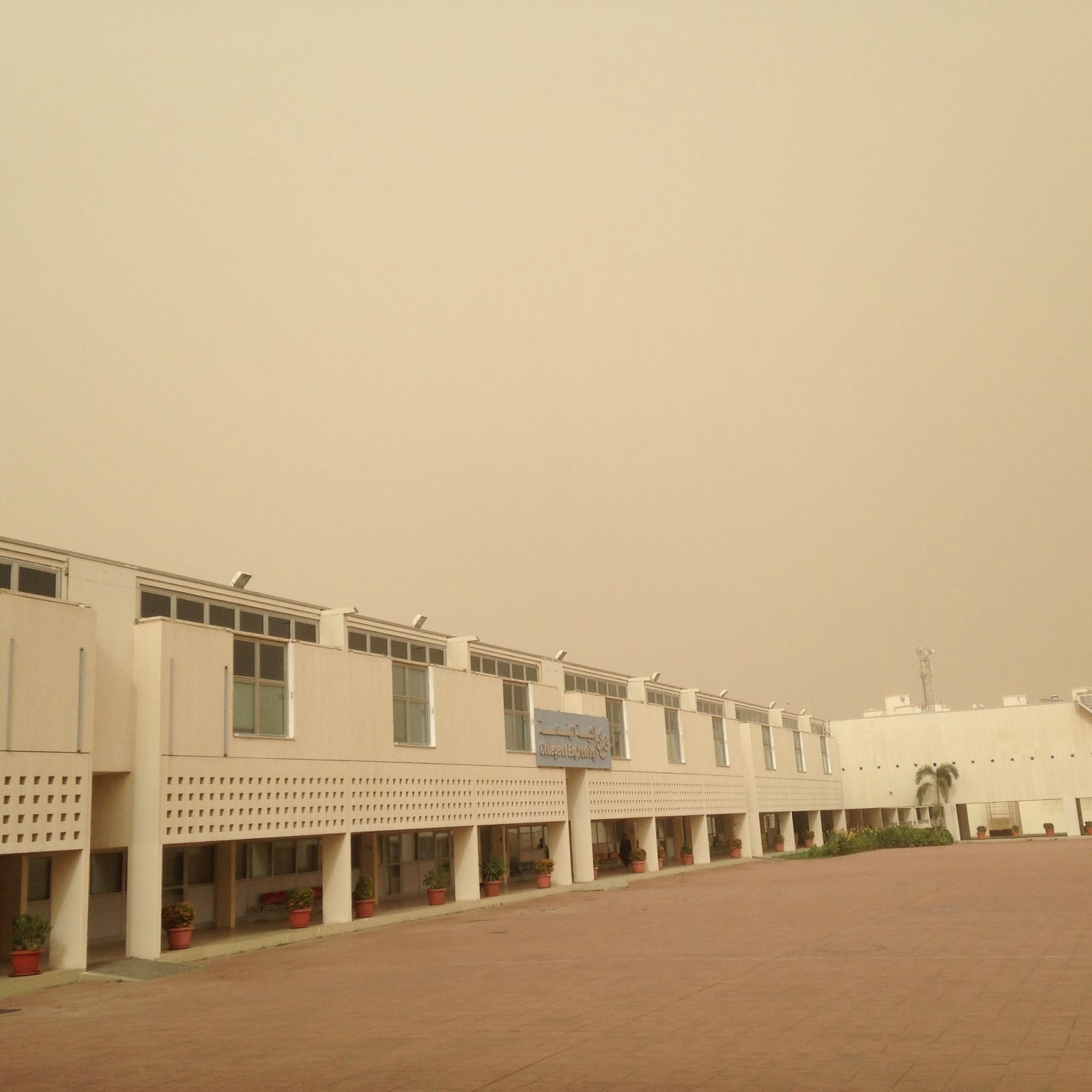
UPDATE: Here is an article on Arab News about the sandstorm that hit Jeddah yesterday. We had wind gusts up to 55km/h (40-41mph) and visibility of only 1km (0.6mi). It looks like it will continue into today due to winds from both the northern and southern directions.

Original Post:

I was going to post more pictures of Al-Balad district, but then we had our first dust storm since arriving in Jeddah.

And it won't be our last. These things are pretty common in this part of the world as the seasons change.

Although I knew we were coming to the desert and I have read about dust storms here, it still took me by surprise. However, I was told by a co-worker that what we saw today was nothing, and that I should go to the capital, Riyadh, to see how I like the dust storms there.

I'll pass.

Check out the pictures I took from the time I left my office to when I got home.

Haboob Jeddah Saudi Arabia
Leaving my office at the end of the day and noticed something was a bit off. The tiles outside are usually white and shiny and clean.

Haboob Jeddah Saudi Arabia
My first view of the sky as I left the male faculty office building.

Haboob Jeddah Saudi Arabia
I turned around as I approached the exit and this is what I saw. The sky is usually bright blue, not brown.

Haboob Jeddah Saudi Arabia
To the right...

Haboob Jeddah Saudi Arabia
To the left...

Haboob Jeddah Saudi Arabia
Leaving the university... Now we're in the thick of it.

Haboob Jeddah Saudi Arabia
Really poor visibility to say the least.

Haboob Jeddah Saudi Arabia
Walking to get a cab home.

Haboob Jeddah Saudi Arabia
Mariel is toughing it out like a champ.

Haboob Jeddah Saudi Arabia
Her head scarf came in handy. This is the first time she is really glad she has to wear it. And that's not the back of her head. She's facing me.

Haboob Jeddah Saudi Arabia
On the way home in the cab. We can usually see those buildings in the distance.

Haboob Jeddah Saudi Arabia
It's blocking out the sun!

Haboob Jeddah Saudi Arabia
Not the Porsche. Not the Porsche!

Haboob Jeddah Saudi Arabia
Another car in our compound.

Haboob Jeddah Saudi Arabia
The inside of Mariel's sunglasses when we got home.

Haboob Jeddah Saudi Arabia
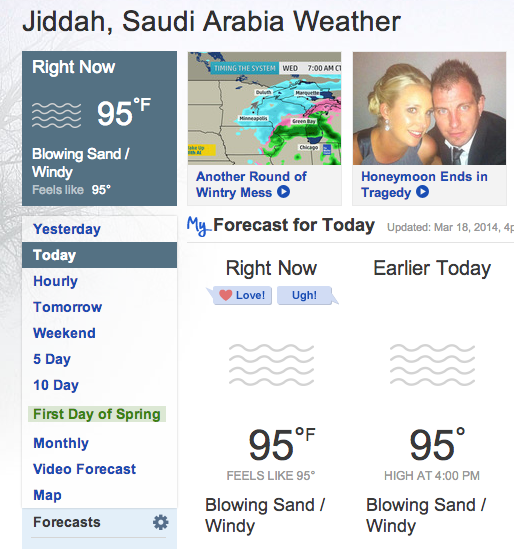
This is how weather.com depicts it.

Okay, I'm gonna go put my face under the shower head.
Read More

Monday, March 17, 2014

What the Heck is Environmental Science?

Environmental Science

I recently asked my students this question on a quiz (not in those words) and it got me thinking. It may seem like an easy answer at first, but once you start thinking about it (too much in my case), it gets a bit more complicated.

So let's stick to the basics...

Environmental science lies at the intersection between people and the Earth - and it is not just one science.

Rather, it is an interdisciplinary field involving many of the natural and social sciences. The natural sciences include biology, ecology, and physical sciences such as chemistry. The social sciences include sociology, economics, and political science. Many of the natural sciences overlap each other, as do the social sciences.

The natural sciences tell us how the Earth, or environment, works. The social sciences tell us how people and economies work. Environmental science, therefore, tells us how the environment works, how people work, and more importantly, how we impact the environment and how it impacts us back.

So, what is "the environment"?

The environment can be divided into four main "spheres":

1) Atmosphere (Air)
2) Lithosphere (Land)
3) Hydrosphere (Water)
4) Biosphere (Living Things)

These spheres are constantly exchanging energy and matter with each other, absorbing our pollution, and making life on Earth possible. Every day, each one of us relies on these four spheres to live. No need to get into the science, but no one can last very long without all four.

Given that, environmental science also asks: "How can we can continue to develop and improve our standard of living while preserving the life-sustaining capacity of the Earth for future generations?" This is more often referred to as sustainable development, or sustainability.

The most important thing to keep in mind, however, is that the Earth will be fine. It has been through much worse in its 4.5 billion year history than us measly, little humans. We won't be fine if we don't clean up our act. Rather than saying "save the environment," we should be saying "save ourselves, from ourselves."

I hope this helps. And I hope my students read this!
Read More

Sunday, March 16, 2014

Window Shopping at the Al-Balad Souqs in Jeddah

Over the weekend, my wife and I made the short trip over to the Al-Balad district of Jeddah to do some window shopping, as well as to sightsee.

Al-Balad, the historic center of Jeddah, is the oldest part of the city. Most historians agree it was founded in the 7th century AD, when it was part of the main Hajj route for pilgrims heading to Mecca. The souq, or open-air marketplace, naturally evolved to serve these pilgrims. To this day, Jeddah remains the main route to Mecca for many pilgrims, whether by air, land, or sea. They don't call Jeddah the "Gateway to Mecca" for no reason...

The historical area of Jeddah is considered one of the most important areas of the city. It is the perfect blend of old and new, where traditional Arabian architecture meets modern urban expansion. It also has some good shopping, as you'll see below.

Al Balad Jeddah Souq or Souk
One of the many corridors in this maze of shops.
Al Balad Jeddah Souq or Souk
Stacks of prayer rugs.
Al Balad Jeddah Souq or Souk
So. Many. Purses. Among other things.
Al Balad Jeddah Souq or Souk
Fancy abayas for the ladies.
Al Balad Jeddah Souq or Souk
Another corridor. They come in all shapes and sizes, just like the items for sale.
Al Balad Jeddah Souq or Souk
Beads h'ya! Get your prayer beads!
Al Balad Jeddah Souq or Souk
Ghutras for the men.
Al Balad Jeddah Souq or Souk
If we ever need a suitcase to come back home, I know where I'm going.
Al Balad Jeddah Souq or Souk
These two insisted on a photo. Hopefully I can make them famous.
Al Balad Jeddah Souq or Souk
Prayer time is over. Time for a snack!
Al Balad Jeddah Souq or Souk
This guy is a boss.
My next post will be on the buildings and architecture of the Al-Balad area. The pictures are really cool (we think). Check back soon for that!
Read More

Saturday, March 15, 2014

My First [Environmental] Impression of Jeddah

Actually, I don't see much green in Jeddah...

A quick foreword: This post isn't meant to criticize Jeddah, but rather to provide an honest account of what I see, as well as to educate.

I've been here for about one month and I've seen very little in terms of environmental awareness or an environmental movement. Think United States before the 1970's...

I've seen a total of three people riding a bike - everybody else who isn't walking is in a car. When I ask my environmental science students how many of them walk to school, ride a bike, or use public transportation, no one raises their hand. This is as much of a culture issue as it is a city design and climate issue. They don't really have a choice.

For me, the Jeddah metro can't come soon enough.

Recycling, like bicycling, is almost non-existent as well. The only recycling options I've seen are on campus, and even those aren't really utilized. This is just part of the overall problem of waste management in the city, which has much room for improvement.

Recycling programs, like those in the United States, where about 1/3 of the waste stream is recovered, can be very effective at reducing the amount of waste that ends up in landfills. The contamination of drinking water supplies is a potential scenario if the landfills are not designed, built, operated, and closed properly.

Clean drinking water and transitioning to clean, renewable sources of energy are two other human and environmental health issues that will need to be addressed.

I'll keep looking for signs of green in Jeddah, but I don't have high hopes, at least not in the near future. This does mean one thing though: opportunity.
Read More

Friday, March 14, 2014

Cats of Jeddah: Part 1

Inspired by Mariel's feline photography, I've decided to start a series dedicated to the street cats of Jeddah. This is just the first set of many kitty cat photos to come.

A word from Mariel:

I learned a lot about Saudi Arabia before we arrived. I knew the weather would be hot, I knew there would be a language barrier, I knew there may not be a plug that fit my blow dryer, and I was fully prepared. But nobody told me the streets of Jeddah would be inhabited by thousands of adorable little cats!

They are everywhere, and it's not unrealistic for your class to be disrupted by a vicious cat fight outside the door. Nor is it unlikely to walk up the steps to your apartment and find a tiny kitten hiding on your doorstep. We've even witnessed a mama cat caring for her just-born kittens.

Here are just a few of the cats I've captured thus far:

Cats of Jeddah
First cat photo I took, which inspired this entire series. 

Cats of Jeddah
Daydreaming.
Cats of Jeddah
Anti-cat propaganda. At least someone thinks it's wrong. 
Cats of Jeddah
We saw this mama the day her kittens were born. They couldn't walk yet and she was carrying them in her mouth, one by one, from one side of the walkway to the other. A few days later, here they are, happy and healthy and nursing. We didn't want to get too close for this pic.
Cats of Jeddah
Yawning or hissing? Leave your vote in the comments.
Cats of Jeddah
This was frowned upon by the local passersby. 
Cats of Jeddah
Tiger cub,  I'm convinced. 
Cats of Jeddah
Neighborhood watch.  
Check back soon for the next set of feline fotos!
Read More

Thursday, March 13, 2014

4 Green Products From Origin Recycled Goods

Scott Westbrook makes new things out of old things.

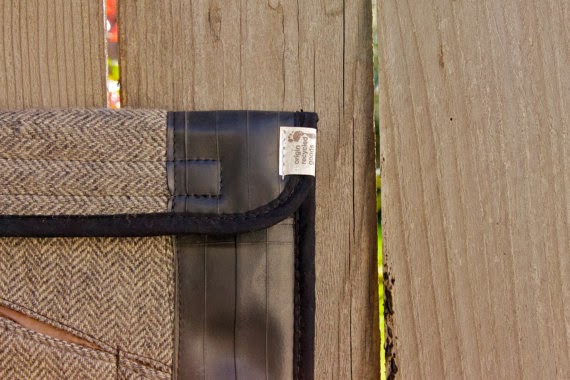
His company, Origin Recycled Goods, handcrafts products such as wallets, belts, watches, and sunglasses out of previously discarded materials. The process is known as upcycling, and nearly all of the material used in his products is salvaged, then it is carefully transformed into useful products.

In Scott's own words: “We aim to reduce the amount of waste reaching landfills by intercepting it and providing a clean, durable, and sustainable product.”

Check out these samples from his Etsy shop and buy things you can feel good about.

1) 100% Upcycled Bike Inner Tube Duffle Bag ($110)


Read More

Wednesday, March 12, 2014

My Introduction to Islam

Group Prayer Islam

I'm fairly confident you read the title of this post and your imagination began painting a much more interesting picture than I could ever do with words (or video in this case), but I'll give it a shot.

Below is a video of my fellow teachers at Effat University in Jeddah, Saudi Arabia taking a timeout to perform one of their five daily prayers.

I asked my colleague, Dr. Mohammad Khalid, Professor of Islamic Studies here at Effat University, exactly what they were doing and why they were doing it. He offered the following highlights as a good introduction to the many prayers of Islam.

1) Before you pray, you must be in a state of purity, or "Taharah." This can be acquired by washing certain parts of your body, and is known as "Wudu" in Arabic. It must be performed after losing that state of purity. This is about inner purification as much as it is about outer purification.

2) Since there is no proper mosque, they use portable prayer rugs to ensure a clean area for prayer.

3) After the rugs are put down, there is an "Adhan", or call for prayer. It is performed by the "Muadhdhin", the caller. The group is gathered like this because the five obligatory, daily prayers must be performed collectively.

4) The "Imam" is the person who leads the prayer, and in this case, it is Dr. Khalid. Generally, the Imam is more knowledgable about Islam than the others, but anyone can lead the prayer - there is no criteria. Everyone in the group must follow the Imam, and as you can see in the video, they all follow in harmony. 

5) This particular prayer is known as the "Asr" prayer, and is one of the five daily prayers. The movements, known as "Rakah", are performed four times each.

6) During the prayer, the Quran is recited. The first chapter of the Quran, "Al Fatihah", is recited in every Rakah. Other than that, it's up to you what verses you recite.

7) Before changing positions (ex: transitioning from standing to kneeling), they hail God by saying "Allahu Akbar", meaning "God is great."

8) Upon ending the prayer, the Imam extends blessings and peace to those on his right and THEN his left (in this order). Then the rest do the same for everyone else.

Did I get that right Dr. Khalid?!?!


OR you can watch the video here.
Read More

40 Green Travel Tips From Green Global Travel

Green Global Travel

Check out these green travel tips from Green Global Travel, an eco-tourism, nature/wildlife conservation, and cultural preservation magazine co-founded by Bret Love and Mary Gabbett.

Adhering to one, some, or all of these tips will make you a more responsible traveler and will reduce your environmental footprint.

Below are just a few to get you started. You can read the full story here.

TIP FOR GETTING THERE

1. Book non-stop flights whenever you can: It’s takeoffs and landings that create most of an airplane’s carbon emissions.

TIP FOR CHOOSING A GREEN HOTEL

6. When traveling in the U.S., check to see if the hotel has LEED Certification from the U.S. Green Building Council, which judges on sustainable site development, water savings, energy efficiency, material selection, indoor environmental quality, and innovation in design.

WATER-SAVING TIP

11. Take a BPA-free water bottle you can refill over and over again.

ENERGY-SAVING TIP

16. When you leave your room, turn off all lights, heat/AC, and television.

GREEN HIKING TIP

21. Marked trails are there for a reason. Stick to the path to avoid harming native flora.

GREEN SHOPPING TIP

26. Buy locally made products, rather than those that have been imported. Items that are flown or shipped in have a much larger carbon footprint, and who wants a souvenir from an Asian assembly line?

ECO-TOUR TIP

31. Travel with small group tour operators, which tend to have less of an environmental impact. Membership in an organization like The International Ecotourism Society is a good sign that the tour operator tries to conduct itself in a responsible, sustainable manner.

TIP FOR BEING A TRAVELER, NOT A TOURIST

36. Honor local customs. Do a little research to learn about the local cultural traditions, so that you can speak and behave appropriately.
Read More

Monday, March 10, 2014

5 Quick Facts About The Atmosphere

After giving a lesson to my students on the awesomeness of the atmosphere, I thought I would share with my readers some of what we learned in class. So here are five quick facts about the Earth's atmosphere that I hope you will find as interesting as we did!

1) The Atmosphere is Mostly Nitrogen
Nitrogen N2


Wait, what? Nitrogen?

Yes. Nitrogen. N2 to be exact. Remember diatomic elements from chemistry class?

Okay, take a deep breath. Guess what. You just breathed in about 78% N2. You also breathed in about 21% O2 (phew!) and 1% of other trace gases.

The atmosphere used to be ALL Nitrogen and NO Oxygen a few billion years ago. Then blue-green algae and other photosynthetic organisms came along and started pumping oxygen into the air.


2) Carbon Dioxide Makes Up a Tiny Portion of the Atmosphere
Carbon Dioxide (CO2)


Part of that 1% of trace gases is CO2, which has a current concentration in the atmosphere of about 400 parts per million (PPM) - or 0.04%. That's pretty small.

But it’s causing global warming and climate change, right?

Yes, it is. Something to think about...


3) The Troposphere is Very Unstable
Troposphere


The troposphere is where we live. It's the layer of the atmosphere closest to Earth. Here, air temperature decreases as altitude increases. This means colder air sits on top of warmer air. Colder air likes to go down. Warmer air likes to go up. So there is a lot of vertical mixing of air in this part of the atmosphere, and is therefore relatively rough.

This is where weather takes place and where nearly all of the water in the atmosphere is located.


4) The Stratosphere is Very Stable
Airplane in Stratosphere


The stratosphere is the next layer up. Due to the higher concentrations of ozone (O3), the temperature in the stratosphere increases as altitude increases (opposite of the troposphere). This means that warmer air sits on top of colder air. Warm air likes to be on top. Cold air likes to be on the bottom. So there is not much vertical mixing of air and it is less turbulent than the troposphere.

That is why airplanes typically fly in the lower stratosphere – above the clouds, above the weather, and above the turbulent troposphere.


5) The Ozone Layer is Located in the Stratosphere
Atmosphere


You've probably heard of the ozone layer. And you've probably heard of the ozone hole. But do you know where they are?

Well, the ozone layer is located in the stratosphere, and it is the portion of the atmosphere where ozone (O3) concentrations are the highest. This ozone is good because it protects us from the harmful effects of UV rays, among other things.

The ozone "hole" is a thinning of this ozone layer, so it's not actually a hole. And it's not just one "hole", there are "holes" above the north and south poles and other areas on Earth.

The "hole" above Antarctica is the one we usually hear about, and is the worst from September to November (at one point it reached the southern tip of South America). The Arctic hole is at its worst from January to March.

Cool, right?
Read More

Wednesday, March 5, 2014

7 Must-Have Bookmarks for an Environmentalist

Recycled Bookmarks

Update: I have added one more website to this list (The Encyclopedia of Earth).

Original post:

I am somewhat disappointed that I haven't written about environmental or sustainability topics since leaving Washington, D.C. for the Middle East. If you read my most recent posts, it's obvious why.

Now that the transition is over and things have settled down, I figured I'd get back into the swing of things by sharing my go-to environmental websites. These sites have become almost daily reads for me, and I suggest them to my students for improving both their understanding of environmental topics as well as their English. I hope you find them useful and I hope there is room on your bookmarks bar for them :)

1) Environmental News Network (ENN)

Environmental News Network (ENN)


The Environmental News Network is by far my favorite environmental news-blog. It's not like many other green news-blogs like TreeHugger or Grist that regurgitate stories like sustainability efforts of companies, how to convert an old trailer into a tiny home, or pictures of exotic flowers or animals. I'm all for companies being socially and environmentally responsible, people reusing materials to make something new and useful, and checking out things I've never seen before, but I prefer to DO those things rather than read about them.

I want to learn the science behind the topics I'm most passionate about, and ENN helps me do that. They compile articles from very reputable sources including The Ecologist and the Yale Environment 360 blog to help me understand the problems the world faces. If you choose just one website to read environmental news and learn about the topics, choose ENN.

2) Environmental Protection Agency (EPA)


If you want to learn about environmental issues and laws, go here. Period. It is in my opinion some of the best information available on these topics. Not only is it reliable, but also really well-written, organized, and presented in a way we can all understand. Whether you have a Ph.D. in Environmental Studies or are reading about environmental topics for the first time, you'll find the EPA website useful. I reference it a good bit for my lectures and I encourage my students to visit the site to learn more about the topics we discuss in class.

3) The Naked Scientists


I actually just learned of this website this past week - and it has become an instant favorite. I referenced it for one of my lectures on the water cycle. I was wondering just how constant the total amount of water on Earth is. I read a response from a professor of atmospheric, oceanic, and planetary physics at Oxford University and found out the amount of water on Earth and in our atmosphere does remain fairly constant on a geologic time scale (water has a hard time escaping the Earth and our atmosphere because of gravity and because it condenses and falls back to Earth at much lower altitudes than the outer limits of our atmosphere).

The Naked Scientists is a group of researchers from Cambridge University that interviews renowned scientists and researchers on various scientific topics and presents their answers to the public using different mediums. Their goal is to promote science, help you understand it, and have fun while doing it.

4) Coursera

Coursera


If you've never taken a course on Coursera, you might be wondering why I have it listed here. My response to that is the picture below:

Coursera

That is a screenshot of my course dashboard. As you can see, they offer some great courses on many different sustainability topics. You can watch video lectures, read their recommended readings, and participate in online discussion. Plus, these courses are taught by professors from very reputable universities around the world. Oh, one more thing - it's FREE.

5) The Economist

The Economist


Why the Economist? Well, aside from writing a lot about China, which anyone wanting a global perspective of sustainability should love, the Economist has other very insightful articles on environmental issues and energy topics. You'll also learn a lot about economics, geopolitics, and the world in general. It's really good stuff.

6) Renewable Energy World

Renewable Energy World (REW)


You can't talk about environmental science or sustainability without talking about energy. And you can't talk about energy without talking about renewable or alternative sources of energy. If you want to be able to hold your own while talking about solar, wind, or tidal energy, go to Renewable Energy World and get your learn on. You'll learn about the latest advances in technologies, industry trends, and the science behind it all.

7) Encyclopedia of Earth

Encyclopedia of Earth


The Encyclopedia of Earth should perhaps be #1 on this list. It is an environmental science teacher's dream. It has articles written on a wide variety of topics in the physical and social sciences. Topics include everything from climate change and agriculture to population and economics.

You can also find photo galleries, videos, science news, and curricula.

The content is produced by experts in their respective fields and is continuously updated by the community of authors, so you can be assured that what you learn is accurate and up-to-date.

Well, that's my list. In my opinion, it's a good one. What do you think?
Read More